
AEM TestPro CV100 multifunction Cable Certifier
- Model
- AEM TestPro CV100
- Calibration
- NIST-traceable · 2026-06-08
- Price
- $4,590
- Status
- In stock
- RFQ ref
- CV100
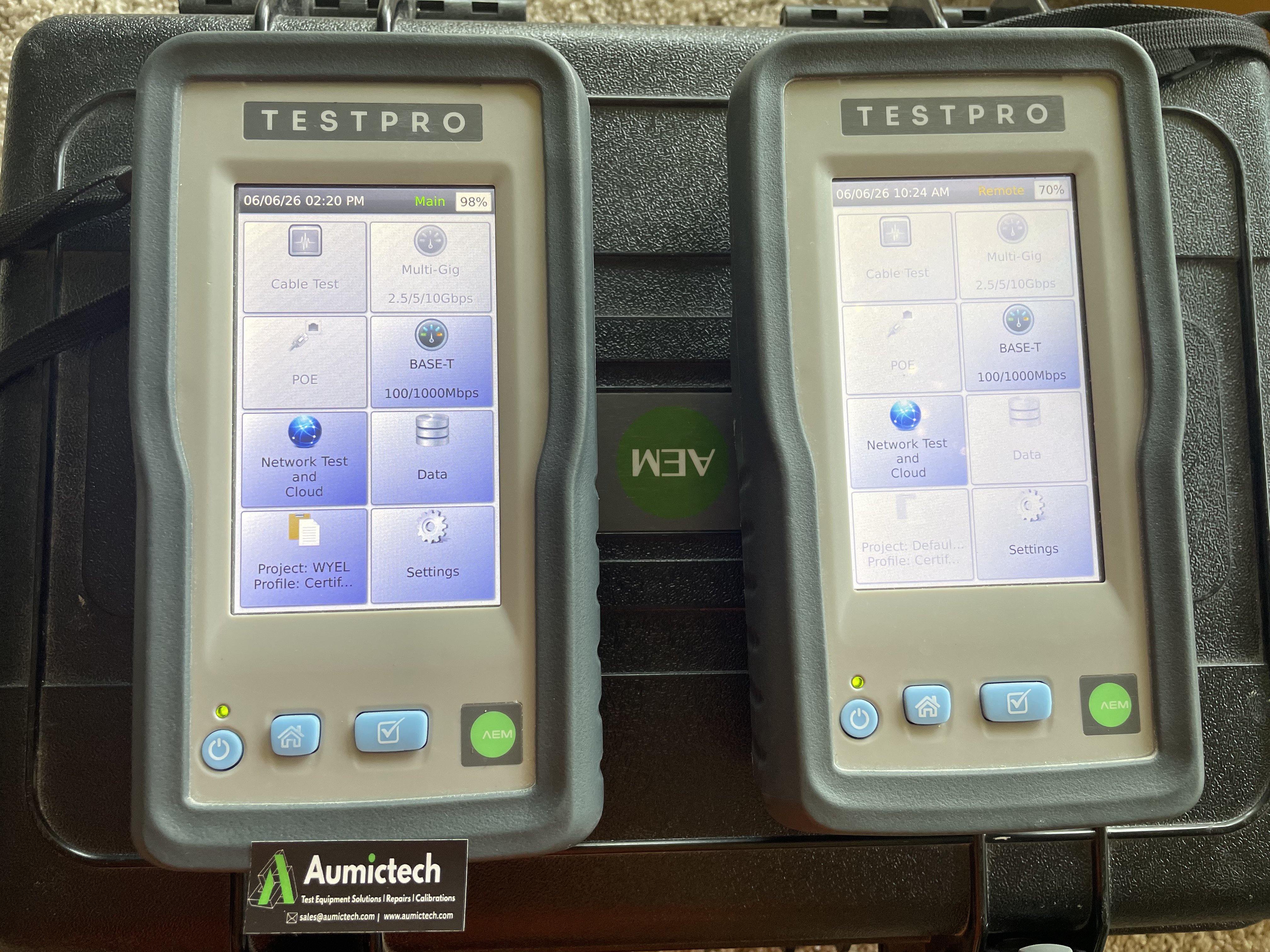
This unit
New and used available. Comes with carrying case, channel adapter, Cat 6A adapter, Single mode adapter, Multi mode adapter, permanent life adapter carrying straps and connectors.
Verification before listing:
- Cable Test
- OTDR Test
- Multimode Test
- Ethernet Test
The AEM TestPro CV100 is a multifunction cable certifier built for copper and fiber certification in structured cabling, data center, and smart building environments. It runs a full Autotest in 4 to 6 seconds, covers TIA and ISO/IEC compliance standards from Cat5e through Cat8, and handles fiber optic insertion loss on the same platform through hot-swappable adapter modules. One tester covers the copper and fiber work without carrying two separate units.
Key Specs
Copper Standards: TIA-568, ISO/IEC 11801, Cat5e, Cat6, Cat6A, Cat7, Cat7A, Cat8
Frequency Range: Up to 3GHz (Cat8 / Class I testing)
Accuracy: Exceeds ANSI/TIA-1152-A Level 2G for Cat8
Autotest Time: 4 seconds (Cat6A channel or permanent link)
Copper Tests: Wiremap, length, insertion loss, NEXT, FEXT, ELFEXT, PS-NEXT, PS-ELFEXT, return loss, TCL, MPTL, resistance unbalance, propagation delay, delay skew
Distance to Fault: Yes, based on NEXT and return loss TDR plots
Multi-Gig Validation: 1 / 2.5 / 5 / 10GbE link validation via SNR and BER testing
PoE Testing: Yes, PoE and PoE+ load testing with four-pair verification
Single-Pair Ethernet: Yes, SPE testing to 1,000m cable length, down to 100kHz
Fiber Testing: SM and MM insertion loss via adapter modules (EF compliant source, integrated VFL)
Lowest Test Frequency: 100kHz (vs 1MHz on competing certifiers)
Adapter Interface: 60-pin high-frequency connector, hot-swappable, rated 5,000 insertion cycles
Data Transfer: USB Type-A, Micro USB, USB cable
Power: 5V 3A supplied, 5 to 12V supported, 2.1mm DC jack
Display: Touchscreen color LCD
The 100kHz lower frequency limit is a practical differentiator. Most competing certifiers start at 1MHz. For Single-pair Ethernet and longer cable runs where RF performance at lower frequencies determines whether the link actually works, measuring from 100kHz gives you data the other tools miss.
TCL (Transverse Conversion Loss) is included in the standard Autotest. Most certifiers require a separate test step or skip it entirely. TCL measures the conversion between differential and common mode signals on the cable pair, which matters for PoE reliability and noise immunity in installations where pairs carry both data and power simultaneously.
The modular adapter system is what makes the CV100 worth carrying to mixed copper and fiber jobs. Copper adapters, SM fiber adapters, MM fiber adapters, OTDR adapters, and SPE adapters all use the same 60-pin hot-swappable interface on the main unit. Swap the adapter at the job site, no recalibration needed between copper and fiber tests.
This unit was tested at our Downingtown, PA facility before listing. Autotest was run on a known-good Cat6A link, results were verified against standard pass/fail limits, and display and adapter interface were confirmed operational.
What adapters are included with this unit?
Adapters vary by unit and kit configuration. Contact us before ordering for a confirmed accessories list on the specific unit in stock. Common adapter kits include copper channel and permanent link adapters, SM/MM fiber adapters, and reference launch cords.
Does it replace a Fluke DSX or Versiv?
It tests to the same TIA and ISO standards and meets or exceeds Level 2G accuracy for Cat8, so for standard structured cabling certification work the answer is yes. AEM publishes a tester comparison guide if you want a side-by-side breakdown. The CV100 also covers SPE and Multi-Gig link validation that the DSX platform does not handle natively.
Can it test PoE on all four pairs?
Yes. PoE testing on the CV100 verifies load conditions and resistance unbalance across all four pairs simultaneously, which is the correct way to test PoE+ and 4PPoE installations where all pairs carry current. Single-pair PoE verification misses resistance unbalance faults that cause heat buildup and premature equipment failure.
Does firmware need to be updated?
AEM releases firmware updates periodically through their cloud platform. We recommend checking for current firmware after receiving the unit. We confirm the firmware version installed on the specific unit at time of shipment on request.